Permanent Lighting
Will Permanent Lighting Damage My Roof, Soffit or Fascia? A Huntsville Homeowner's Guide
New Age Lights • August 2026 • Huntsville, AL • 8 min read
Where the track actually goes
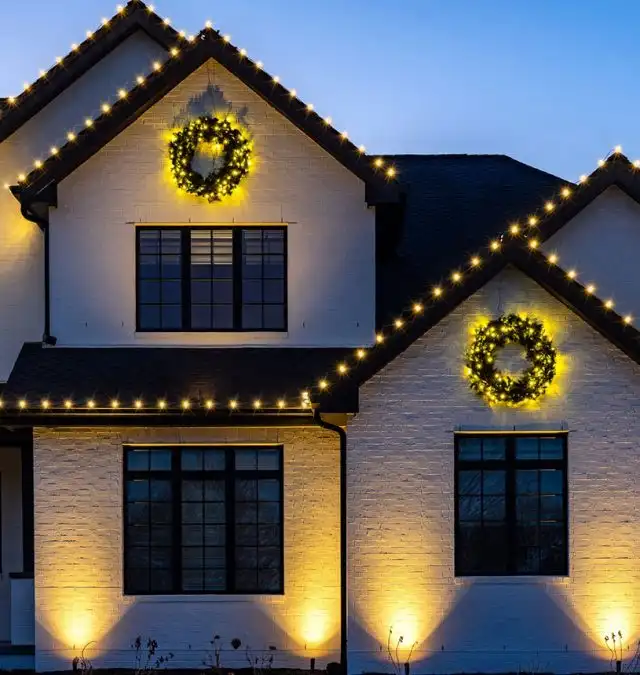
People picture permanent lights as something bolted to the roof. They are not. Both systems we install, JellyFish and Bosso, are a slim aluminum channel on the vertical face of the fascia board or tucked under the drip edge, angled so the light washes down the wall or out to the street. The shingles above are never touched.
That is the same surface your gutters are already screwed to. The track is lighter than a gutter, carries no water load, and is fastened with screws sized to the fascia. The channel is color-matched to your trim so it reads as fascia from the street.
On some elevations the cleaner line is the soffit, the underside of the eave, which points the light straight down the wall and suits a shallow fascia or a drip edge occupied by gutter guard. Either way the fastening is into trim, not roofing.
How the wire gets to the garage
The lights are low voltage. The wiring runs inside or alongside the track and needs to reach the controller, which usually lives in the garage on a dedicated circuit. Bosso's controller is UL-rated and waterproof; one JellyFish controller powers roughly 263 feet of track.
The wire leaves the track at a corner or over the garage and passes into the soffit and through the attic, or down a corner board, to the controller. Every penetration is a small sealed hole in trim, not roofing, placed out of sight from the street. Nothing runs across the roof deck and nothing is clipped to shingles.
On the acreage lots around Owens Cross Roads the wiring is usually the biggest question on the job, not because of the roof but because getting rated power to the right point of a large property takes planning. We settle the circuit at the consult.
What changes with Huntsville's roofing and trim
Huntsville's housing stock has a two-hundred-year spread in it, and the edge of the roof is where that shows. Here is what we look at on each kind of house.
| Neighborhood type | Typical roof and trim | How the track mounts |
|---|---|---|
| Twickenham, Old Town | Antebellum and Victorian; metal or slate roofs, deep eaves, wood cornices, gutter replaced piecemeal over a century | Fascia or cornice line only, never through metal or slate. Run designed around the trim detail. District and association rules requested before design. |
| Blossomwood, Five Points | Mid-century; brick, shallow fascia, wood or later aluminum trim, some cornice detail | Fascia mount where depth allows; the system that seats most discreetly on a shallow edge is the recommendation. |
| Meridianville, Harvest older stock | 1970s and 80s brick ranches and farmhouses; shallower fascia, gutter replaced at different times | Fascia mount matched to the actual edge. Fixings chosen for open-lot wind and a wet December. |
| Madison, Providence, Hampton Cove, Clift Farm | Modern; straight continuous fascia in aluminum wrap or fiber cement, seamless gutter, vinyl or fiber cement soffit | Cleanest install we do. Track seats along the fascia and reads as trim in daylight. Height, not material, is the variable. |
| Monte Sano | Mixed eras, additions that break the roofline, wooded steep lots | Each section's edge assessed separately; access decides the day more than the fascia does. |
Metal and slate
These are the roofs people worry about most, and rightly: a fastener through slate is a broken slate and a fastener through a standing-seam panel is a leak. We do not fasten into either. On a Twickenham or Old Town roof the track goes on the fascia or cornice face below the roofing, the wire exits through trim, and nobody walks on the slate. The run takes longer to design because the cornice is deep and a daylight-visible fixture is the wrong answer on a street like that.
Brick
Brick is not the problem it looks like, because the track never touches it. A brick ranch still has a fascia board at the roof edge, and that is where the track lives. A wire drop down a brick corner is a surface-mounted low-voltage run in a color-matched raceway, or it goes through the soffit instead.
Vinyl and aluminum
Most newer Madison and Harvest homes have aluminum-wrapped fascia over a wood board, and vinyl or fiber cement soffit. The screws go through the wrap into the board, exactly as gutter hangers do. Vinyl soffit is not a fastening surface, so on a soffit mount we locate the framing behind it. The wrap color is what we match the track to.
Wood
Painted wood fascia and cornice, common in Old Town and on older Athens houses near the square, is the easiest surface to fasten to and the one where sealing matters most, because a bare hole in wood takes water. Fasteners are sealed and the track matched to the paint. If the trim is due for paint, do it first.
Water, freeze and thaw
The Tennessee Valley's winter is wet rather than deeply cold. December averages a high near 52°F and a low near 34°F, and winter is the wettest season, so a roofline here spends weeks damp, freezes overnight and thaws by afternoon. That cycle pulls a cheap seasonal clip off a gutter in January, and it is why sealing on a permanent install is the job, not a finishing touch.
The track is aluminum and does not rot or rust. The lights are sealed units rated around 50,000 hours by both manufacturers, penetrations are sealed, the controller is rated for where it sits, and the whole system is low voltage. On the open north-county lots around Meridianville, where wind matters more than in town, fixings are chosen to still be holding in January.
Do permanent lights damage the roof or soffit?
No, when the installer follows the rule we follow on every job: fix to the structure at the fascia or soffit, never through roofing material. The failures you may have read about come from the opposite approach, a track screwed up through shingles or a wire stapled across a roof deck, and from adhesive retail strip lights that peel in summer heat and take paint with them. Neither is what a dealer install looks like. The two systems we fit are described on our JellyFish Lighting and Bosso Smart Lighting pages.
HOAs and historic districts
A track that is invisible in daylight answers most of what an architectural review committee cares about, but ask before you install. In the HOA-governed subdivisions across Madison, Hampton Cove and Clift Farm, bring the association's rules to the consult and we design inside them from the start.
Huntsville's locally designated historic districts, Twickenham, Old Town and Five Points among them, are different. Exterior changes visible from the street there typically go through the city's historic preservation review, and a permanent fixture on an antebellum cornice is exactly what that review exists for. We ask for the rules before designing, and on some of those houses the honest recommendation is a well-built seasonal display. The approval process is covered in permanent outdoor lighting and HOAs in Huntsville.
Warranty, and what removal would look like
Both systems carry a five-year parts warranty; JellyFish is bumper-to-bumper in year one and Bosso covers labor for one year. Beyond that, we install and service every system we sell, so a run that drops out is a call to our office on Fletcher Street, not a support line.
If a track ever had to come off, it unscrews. What remains is a line of small fastener holes in the fascia board or wrap, which fill and paint like any trim repair, and a sealed wire penetration that can be capped. Nothing on the roofing was touched. In practice removal is rare; the earliest JellyFish installs from 2016 are still running.
What to ask any installer
- Where exactly will the track fasten, and will anything go through the roof covering?
- Where does the wire leave the track, and how is that hole sealed?
- Where will the controller live, and is there a proper circuit there?
- What color is the track, and can I see it against my fascia?
- Who do I call if a section fails in year three?
- Have you installed on this roofing and trim type before?
If the answers involve shingles, staples or a support line in another state, keep looking. For the hardware side, see JellyFish vs Bosso for Huntsville homes; Bosso and JellyFish publish their own installation details.
Frequently asked questions
Do permanent lights damage the roof or soffit?
Not when they are installed correctly. The track fastens along the fascia or under the drip edge, the same surface your gutters already hang from, and nothing is nailed, screwed or stapled through shingles, metal or slate. The low-voltage wire runs along the track and through a sealed penetration in the soffit or a corner to reach the controller. On the metal and slate roofs in Huntsville's older districts we work off the fascia line entirely.
Where does the wire go?
Low-voltage wire runs inside or along the track to a point where it can pass discreetly into the soffit or down a corner, then to the controller, which usually lives in the garage on a proper circuit. Every penetration is sealed. Nothing runs across the roof deck.
Can permanent lighting go on a metal or slate roof?
Yes, because the track does not touch the roofing. On the metal and slate roofs in Twickenham and Old Town we fix to the fascia or cornice line, never through the roofing material, and we design the run around the trim so the track disappears in daylight. Those houses take longer and we ask for any district or association rules before designing.
What if I ever want the track removed?
The track unscrews from the fascia. What remains is a line of small fastener holes in the fascia board or wrap, which can be filled and painted, and a sealed wire penetration that can be capped. Nothing on the roofing itself was touched, so there is nothing on the roof to repair.
Will the track void my roof warranty?
Because the track is fastened to the fascia and not to the roof covering, a correctly installed system does not penetrate the roofing material that a roof warranty covers. If your roofer or shingle manufacturer has specific conditions, bring them to the consult and we will design to them.
Does the track hold up in a Tennessee Valley winter?
It is built to. December here averages a high near 52°F and a low near 34°F and winter is the wettest season, so the system is sealed and low voltage, the track is aluminum, and the controller is rated for the location. Both manufacturers rate the lights around 50,000 hours and warrant parts for five years, and we service what we install.
Have us look at your roof edge
A free consult means we stand under your fascia and tell you exactly where the track would sit, where the wire would go, and whether your trim suits one system better than the other. We work from Fletcher Street across the valley, including Madison and the older districts downtown.
Get a free quote or call (256) 530-0754.